
How to guide your industrial project towards optimal technology?

Introduction: Beyond technological preconceived ideas
In the world of silicone processing, the choice between UNHCR (High Consistency Rubber) silicone gum and LSR (Liquid Silicone Rubber) liquid silicone often crystallizes passionate debates. Some manufacturers consider the LSR to be “more modern” and therefore automatically superior, while others perceive the UNHCR as “outdated”. These technological shortcuts can lead to suboptimal choices, both technically and economically.
Industrial reality is more nuanced. Each technology has its areas of excellence and its limits. The optimal choice depends on a rigorous multi-criteria analysis integrating the geometric, volumetric, qualitative and economic constraints of the project. At PROGRESS Silicones, our mastery of both processes in our workshops in Luberon allows us to support our customers towards the most relevant solution, without technological bias.
This bi-technological expertise is a decisive asset: it guarantees an objective recommendation, based on the overall optimization of the project rather than on the available capacities of the production tool.
UNHCR Silicone Gum: versatility and artisanal mastery
Principle and Technical Characteristics
UNHCR silicone comes in the form of a dense paste, generally packaged in breads or strips. This high consistency requires prior mechanical work - mixing, shaping - before the actual transformation. Two main processes exploit this raw material: compression and injection-transfer.
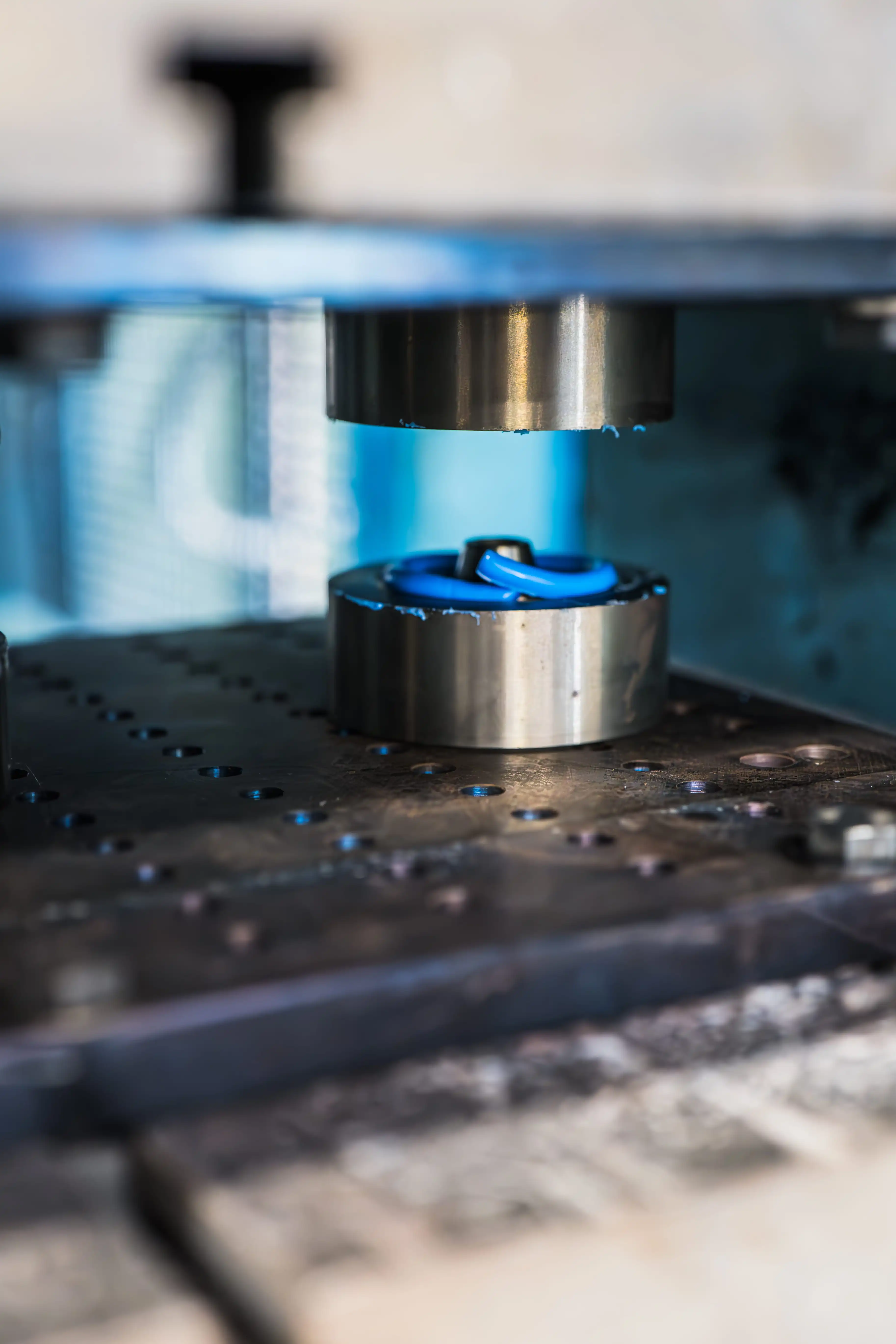
In compression, the preformed gum is placed in an open mold, then compressed by closing the mold under controlled pressure. Vulcanization is carried out hot, generally between 160° C. and 180° C., for a period of time proportional to the thickness of the part. This process makes it possible to effectively evacuate trapped air and to compensate for dimensional variations.
In injection-transfer, the plasticized gum in a heated cylinder is injected under pressure into a closed mold. This variant combines the advantages of compression (management of variable thicknesses) and injection (controlled filling, better definition of details).
UNHCR areas of excellence
UNHCR technology excels in several specific industrial configurations. Small to medium series (500 to 50,000 pieces per year) find in the UNHCR an optimal balance between tool investment and part cost. UNHCR molds, which are less technically complex than their LSR counterparts, allow for faster amortization on intermediate volumes.
Parts of considerable thickness (greater than 5 millimeters) constitute another area of predilection. UNHCR naturally manages variations in thickness within the same piece, offering considerable freedom of design. Industrial joints with large cross-sections, thick technical membranes or massive damping parts make full use of this capacity.
Formulation flexibility represents a major distinctive advantage. UNHCR gums accept a wide range of additives, fillers and pigments without compromising the stability of the blend. This versatility makes it possible to develop materials with very specific properties: electrical conductivity, resistance to hydrocarbons, resistance to low temperatures, tailor-made colors.
Human expertise at the heart of the process
Contrary to popular belief, the human dimension of the UNHCR process is an asset, not a weakness. Our operators develop an intimate knowledge of the behavior of each grade of rubber: optimal plasticity, processing temperature, vulcanization time. This expertise makes it possible to finely adjust the parameters for each batch, guaranteeing constant quality despite natural variations in the raw material.
Demolding, in particular, requires specific know-how. Reading the signs of vulcanization, mastering demoulding procedures for complex geometries, early identification of quality deviations: all skills that transform an industrial process into real precision craftsmanship.
LSR Liquid Silicone: precision and industrial automation
Principle and technological advantages
The LSR uses a two-component system that is liquid at room temperature. The components A and B, stored separately, are dosed with gravimetric precision and then mixed in a static mixing head just before injection. This approach guarantees perfect homogeneity of the mixture and eliminates the variations associated with the storage of pre-mixed material.
The injection is carried out in a heated closed mold, generally between 170° C. and 200° C. The low viscosity of the liquid mixture allows complete filling of the impressions, even for the most complex geometries. Vulcanization by addition is almost instantaneous, allowing very short production cycles.
Dimensional performance and repeatability
The dimensional accuracy of the LSR is its major asset compared to UNHCR. Dimensional tolerances commonly reach ±0.1 millimeters, or even ±0.05 millimeters for the most demanding applications, compared to ±0.2 to ±0.3 millimeters for UNHCR. This precision is the result of several factors: perfect fluidity of the liquid material, absence of density variations, homogeneous and rapid vulcanization.
The repeatability piece by piece is exceptional. The automatic dosing of components, robotic injection and perfectly controlled process parameters eliminate variations related to human intervention. The dimensional variation coefficients fall below 1%, a performance that is inaccessible with traditional technologies.
Technical and economic comparative analysis
Volume decision matrix
Comparative economic analysis reveals net profitability thresholds between the two technologies:
Volumes less than 50,000 pieces/year: UNHCR is generally required. The reduced tool investment (30 to 50% less than the LSR) and the flexibility of production more than compensate for the lower productivity.
Volumes 50,000 to 200,000 pieces/year: Arbitration area requiring project-by-project analysis. Dimensional constraints, geometric complexity and the prospects for the evolution of volumes guide the decision.
Volumes greater than 200,000 pieces/year: LSR is generally becoming more competitive. The amortization of the initial investment is accelerating and productivity gains offset additional tool costs.
The balance point is generally around 100,000 pieces depending on the complexity of the project.
Technical Choice Criteria
Dimensional accuracy required:
• Tolerances ≥ ±0.3 mm: adapted UNHCR
• Tolerances ±0.1 to ±0.2mm: Comparative analysis required
• Tolerances ≤ ±0.1mm: LSR recommended
Wall thicknesses:
• Thicknesses > 5mm: advantageous UNHCR
• 2-5mm thicknesses: Equivalent technologies
• Thicknesses < 2mm: preferred LSR
Geometric complexity:
• Simple geometries: economical UNHCR
• Fine details, ribs: superior LSR
• Complex undercuts: Case by case analysis
Sectoral applications and case studies
Medical sector: requirements and solutions
The medical sector is a perfect example of HCR/LSR complementarity. Implantable devices and direct contact components (heart valves, syringe joints, catheters) require the precision, purity, and reproducibility of LSR. USP Class VI and ISO 10993 certifications are systematically available with both grades.
Conversely, large-scale diagnostic equipment or medical device prototypes find UNHCR a more flexible and economical solution for development phases and limited series.
Food industry: compliance and performance
The food industry uses both technologies according to the applications. Large tank seals and process membranes favor UNHCR for its flexibility of formulation and its resistance to aggressive cleaning. The micro-components of packaging equipment (dosing valves, precision seals) exploit the repeatability of the LSR.
The PROGRESS Silicones approach: bi-technological expertise
Technological choice methodology
Our approach is based on a systematic multi-criteria analysis:
Step 1 - Functional analysis: Definition of the essential technical constraints (precision, mechanical properties, environment of use).
Step 2 - Volumetric evaluation: Projection of volumes over 3 to 5 years to correctly size the tool investment.
Step 3 - Economic simulation: Calculation of the global UNHCR vs LSR costs over the life of the project.
Step 4 - Risk analysis: Assessment of the flexibility required in the face of potential changes in the project.
Step 5 - Substantiated recommendation: Technical and economic summary with alternative scenarios.
Integrated technical support
Our design office supports technological decisions by completely optimizing the part/material/process triptych. The simultaneous design of the part geometry and the mold guarantees the optimal exploitation of the characteristics of each technology.
For UNHCR, we optimize connection radii, recesses and joint surfaces to facilitate demoulding and minimize finishes. For the LSR, we favor the fluidity of the flows, the balancing of the fillings and the evacuation of the air to fully exploit the precision of the process.
Prototyping and validation
Our rapid prototyping capabilities make it possible to validate the technological choice before the final commitment. UNHCR or LSR prototype tools, test series, property validation: we secure the decision through concrete experimentation.
This approach avoids the classic pitfalls: an unsuitable technological choice discovered late, additional tool costs linked to last-minute modifications, disappointing performance compared to initial expectations.
Practical decision guide
Key questions to ask
Before choosing your technology, ask yourself these key questions:
1. What is my realistic volume over 3 years? (Not just the first year)
2. What are my critical dimensional tolerances?
3. Do I need specific material properties? (Color, conductivity, chemical resistance)
4. Can my project evolve quickly? (Need for flexibility)
5. What is my available tool budget?
6. What are my marketing deadlines?
Conclusion: a strategic decision that is being built
The choice between UNHCR and LSR goes beyond simple technological selection: it is a strategic decision that involves the performance, profitability and scalability of your industrial project. This decision cannot be made on the basis of generic criteria or technological prejudices. It requires a rigorous, multi-criteria analysis, integrating all technical, economic and strategic constraints.
UNHCR injection-compression offers versatility, formulation flexibility and economic accessibility for small to medium series. LSR injection guarantees dimensional accuracy, high productivity and industrial reproducibility for large series and demanding applications. Neither is universally superior: each one excels in their chosen field.
At PROGRESS Silicones, our bi-technological expertise is your guarantee of objectivity. We are not defending a technology, we are optimizing your project. This impartial approach, nourished by the daily experience of our teams in Luberon, transforms the complexity of technological choice into a competitive advantage for your company.
The real question is not “UNHCR or LSR?” but “how do you optimize the performance/cost/time equation for your specific application?” This response is built in dialogue with an industrial partner who masters both worlds and can objectively analyze your project.
A silicone part project to be industrialized?
Our design office analyzes your specifications and guides you towards the optimal technology. Technical expertise, the impartiality of advice and the quality of support: three pillars to transform your project into industrial success.